
What UAPs Are Really Teaching Us
Perhaps the deeper mystery lies not only in what these anomalies are, but in how they reshape our collective understanding of what is possible.

Reading time: 7 minutes
Every scientific revolution begins in much the same way.
An anomaly appears.
At first, it is dismissed. Then ridiculed. Then carefully explained away.
Only much later—sometimes decades or centuries later—does something remarkable begin to happen. The anomaly itself may not have changed at all. What changes is the collective architecture through which society decides what counts as reality.
Whether Unidentified Anomalous Phenomena (UAPs) ultimately prove to be advanced terrestrial technologies, extraterrestrial visitors, interdimensional phenomena, or something entirely different remains an open question. Yet regardless of their eventual explanation, they are already teaching us something profound about how consensual reality evolves.
While we naturally ask what UAPs ultimately are, the phenomenon itself poses a different question: What do these anomalies—and their increasingly undeniable reality—reveal about the nature of knowledge itself?
The Anatomy of an Anomaly
Our evolving cultural and institutional response to Unidentified Anomalous Phenomena (UAPs) provides a striking contemporary case study of how reality itself becomes socially stabilized. In previous decades, these phenomena were more commonly termed UFOs, or Unidentified Flying Objects.
For decades, within both the scientific establishment and mainstream discourse, reports of UAPs were comfortably categorized using familiar dismissive frameworks. Although a small but growing number of researchers—including Garry Nolan, Avi Loeb, and several multidisciplinary scientific initiatives—have argued that these phenomena deserve careful investigation, reports of UAPs were long relegated to optical illusions, misidentified atmospheric phenomena, wishful thinking, or the perceptual or psychological errors of individual witnesses. The boundaries of consensual reality remained largely intact because the anomalies were successfully confined within the unreliability of the individual psyche.
In recent years, however, the geopolitical and technological geometry of this consensus has undergone a notable disruption.
The official release of military sensor data, radar telemetry, cockpit videos, and related documentation by the Pentagon and other defense-related agencies has introduced a different tier of evidence into the public domain. Millions of people have now watched officially released military footage documenting objects whose reported behavior—including instantaneous acceleration, trans-medium movement, and other anomalous flight characteristics—continues to be investigated and, in a significant number of cases, remains unexplained. Several scientists studying these incidents have noted that, if the reported performance characteristics are accurate, they would be difficult to reconcile with our current understanding of propulsion, aerodynamics, and, in some instances, established physical models.
The significance of this shift is epistemological before it is ontological. This is because the reality status of an anomaly is inextricably bound to the scale and institutional stabilization of its consensus. Nothing in this shift establishes the ontological nature of the reported phenomena. While intelligence agencies have reportedly long taken these anomalies seriously behind closed doors, what has changed is something prior: the standards governing what is now officially considered worthy of serious public investigation.
Whether these phenomena will ultimately receive a satisfactory explanation remains entirely unsettled. Their true origin—be it terrestrial, non-human, interdimensional, or something else altogether—is still unknown. Definitive conclusions regarding who or what is behind them are, at this stage, premature. They must await hard physical evidence—such as anomalous artifacts or biological materials—subjected to rigorous, transparent, and fully independent peer-reviewed scientific analysis.
Yet even in the absence of an explanatory origin story, the cultural lesson is already profound. A phenomenon once declared impossible and exiled to the furthest margins of respectable discourse is gradually being integrated into institutional reality.
Even before the ontological question is resolved, their epistemological significance is already becoming clear. It is not simply our empirical data that have changed—reports of these anomalies have existed for generations—but also our mechanisms of social validation. The UAP enigma demonstrates that when the architecture of consensus expands to include military instrumentation and credible witnesses, the dominant worldview is forced to widen its perceptual bandwidth. What was once dismissed as an “impossible delusion” consequently becomes an unexplained but increasingly accepted phenomenon.
When the Anomaly Became Personal
Moving from these macro-level architectures of institutional consensus to the raw immediacy of lived experience introduces an entirely different register of challenge—one that brings us directly to the catalytic crucible of nonordinary states of consciousness.
For most of my life, I had little sustained interest in UAPs. Like many people, I found the subject mildly intriguing but never central to either my scholarly work or my personal life. My intuition was simply that, in a universe containing well over two trillion galaxies and hundreds of billions of trillions of planets that may have formed over cosmic history, it would be surprising if sentient intelligence had arisen only once. After all, the basic chemical ingredients from which life eventually emerged—including hydrogen, carbon, oxygen, and nitrogen—have been present since the earliest epochs of cosmic evolution. Beyond that broad cosmological intuition, however, I devoted little attention to the subject.
That changed unexpectedly during an ayahuasca retreat in the Amazonian rainforest.
Years after the healing encounter with the “astral doctors” described in my forthcoming book The Participatory Way, another anomalous experience unfolded that permanently broadened the range of possibilities I was willing to entertain. Although I was vaguely aware that UFO-like imagery appears in some of Pablo Amaringo’s visionary paintings reproduced in Luis Eduardo Luna’s Ayahuasca Visions, I entered the ceremony with absolutely no expectation of encountering anything remotely similar.
At the height of the experience, while my eyes remained open, an oval, metallic-looking craft materialized inside the ceremonial maloca. Its surface was perfectly smooth and seamless, without visible windows, engines, rivets, or any recognizable means of propulsion.
Moments later, a rectangular opening appeared in its side. A ramp slowly extended to the earthen floor, and several seemingly non-human entities began to descend into the ceremonial space. They appeared slender and elongated, with large oval heads and broadly humanoid form, though I retain few detailed memories of their anatomy.
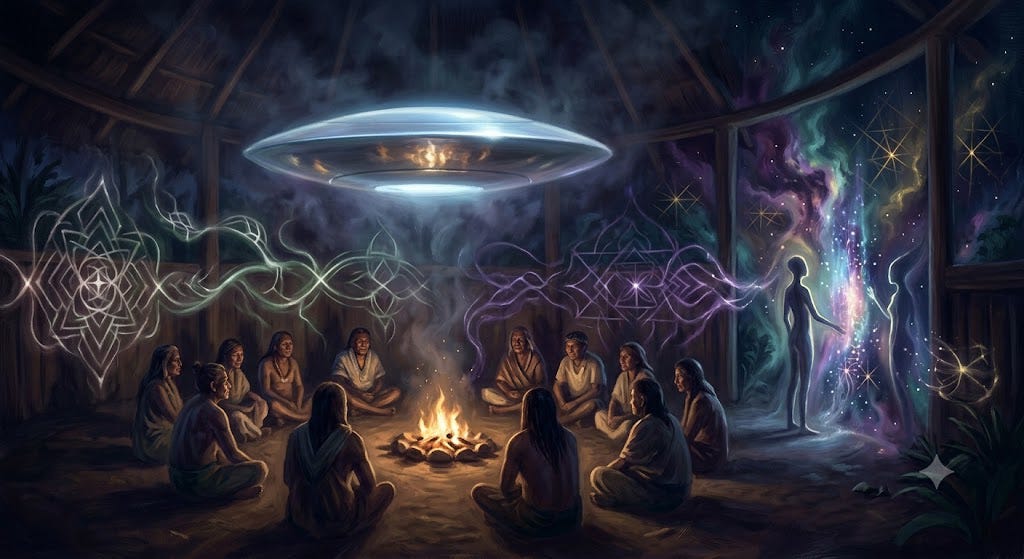
What remains most vivid is not their appearance but my own response: a surge of excitement at the possibility of genuine contact.
Before any interaction could unfold, however, a powerful wave of nausea overtook me and I purged intensely. When I recovered sufficiently to look again, both the craft and its occupants had disappeared.
At the time, I wondered whether the purge had interrupted my visionary perception or whether, quite simply, I was not yet prepared for whatever encounter might otherwise have taken place. I also found myself wondering whether, even though I could no longer perceive them, these beings might somehow still have been interacting with—or perhaps even assisting—other participants in the ceremony.
Needless to say, such reflections remain entirely speculative.
The Lasting Lesson
The lasting significance of this experience was not that it convinced me of the existence of extraterrestrial or interdimensional beings. Rather, it permanently expanded the range of possibilities I could responsibly entertain.
In particular, it made me more open to the hypothesis that at least some reported encounters with non-human intelligences may involve dimensions of reality not ordinarily accessible to everyday waking consciousness. Importantly, this possibility does not exclude a physical extraterrestrial origin. If advanced civilizations exist elsewhere in the cosmos, what appears “interdimensional” from our perspective could simply reflect technologies—or modes of travel—that transcend our current scientific understanding.
From a participatory perspective, experiences of this kind also invite us to consider a more radically plural ontology—one in which conscious agencies may inhabit dimensions or bandwidths of reality ordinarily unavailable to waking awareness. Whether such encounters disclose autonomous realities, emerge through participatory co-creation, or involve some combination of both defies definitive resolution. What they do reveal is the possibility of a cosmos alive with forms of intelligence beyond the narrow bandwidth of ordinary perception.
In my own case, I remain genuinely uncertain about what occurred. Its enduring value, however, lies not in providing an answer but in transforming the questions I was prepared to ask. It reminded me that the deepest obligation of both science and spirituality is not to defend yesterday’s certainties, but to remain genuinely available to whatever reality may yet disclose. That stance of intellectual openness, I believe, is precisely what the unfolding UAP question requires.
To confront the UAP enigma is to prepare ourselves for the possibility that we may not be alone, and that reality itself may prove far more intricate, densely inhabited, and astonishing than our present consensus paradigms have thus far dared to imagine.
Beyond Certainty
Ultimately, the true significance of the unfolding UAP question may have surprisingly little to do with what UAPs ultimately prove to be. This is not to minimize the extraordinary implications that any eventual explanation might carry. If these phenomena ultimately prove to reflect previously unknown terrestrial technologies, evidence of non-human intelligence, or capabilities that radically expand our understanding of physics, such a discovery would rank among the most consequential in human history. Indeed, if these entities possess an independent, objective reality, they would fundamentally shatter the anthropocentric assumption that humanity occupies a privileged place as the sole—or at least the highest—intelligence on Earth, or perhaps even in the cosmos more broadly.
But regardless of how this mystery is ultimately resolved, it has already begun transforming something equally important: our understanding of how knowledge itself evolves. Persistent anomalies remind us that scientific and cultural worldviews evolve not only through the accumulation of new facts, but also through the expansion of the conceptual frameworks that render those facts intelligible. Long before a phenomenon is fully explained, it can expose the hidden assumptions through which a civilization defines what counts as real, possible, or worthy of serious investigation.
This, in turn, points toward the broader contribution of a participatory perspective. It does not ask us to abandon skepticism in favor of belief, nor to replace scientific rigor with metaphysical speculation. Rather, it invites an even more disciplined form of epistemic humility: the willingness to distinguish what we know, what we do not know, and what we do not yet know how to investigate.
The greatest obstacle to discovery is rarely mystery itself. More often, it is our premature conviction that we already know the boundaries of the possible. If that humility is sustained, reality itself may prove far stranger, more creative, and more participatory than we have ever imagined.
This essay is adapted from my forthcoming book,
The Participatory Way: Reimagining Consciousness, Psychedelics, Embodiment, and Culture.
As a token of my appreciation, all paid subscribers will receive a complimentary
e-book edition upon its release.

Overall yeah. Good reflections but it feels incomplete. If I read it right you are saying they embody or represent a revolution in culture, cognition, belief. Queue in Kuhn and scientific revolutions.
If I recall Jung described them as psychological phenomena that represent wholeness. That also seems incomplete. And I think you are on to something with them being anomalies. Dreams and psychedelic experiences have anomalies that change the narrative, change the context like in your ayahuasca experience.
I would argue that they challenge the mundane world view and initiate a response that is either transcendent or profane. Our modern mind culture is in many ways trapped in the Mundane. And these beings-manifestations shift that mindset and way of perceiving into something greater, something grander and more challenging for our limited primate minds. Think of the monolith in 2001.
"The significance of this shift is epistemological before it is ontological" — that sentence is the whole argument. Before you can ask *what* something is, a prior architecture decides whether it's the kind of thing worth asking about. The Pentagon footage didn't change the phenomenon; it changed which instruments count, whose testimony enters the record. Then you bring that same humility to your own encounter — holding "autonomous intelligence, a participatory visionary disclosure, an internally generated symbolic process, or some combination" without collapsing any of them. Most people can't tolerate that superposition. You let it breathe. There's a discipline here beyond open-mindedness: standing with a saturated phenomenon without extracting a verdict. Witnessing, not observation. The craft may have vanished from the maloca, but the expansion of what you could responsibly entertain is permanent. That's the real contact.
— Iman and Darja